
Services

Robotic Surgery

Dr Alan Cheung

Dr Alan Cheung

Senior Consultant Orthopaedic Surgeon in Singapore

MBBS (London), MRCS (England), FRCS (Trauma and Orthopaedics, England), Diploma in Sport and Exercise Medicine (UK), Fellow of the European Board of Orthopaedics and Traumatology, American Academy of Orthopaedic Surgeons (AAOS)

What is Robotic Surgery?

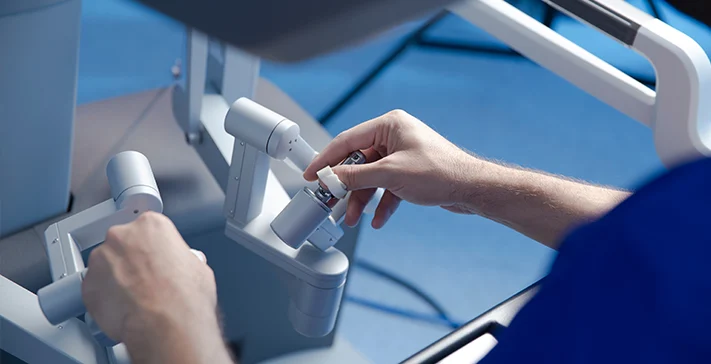
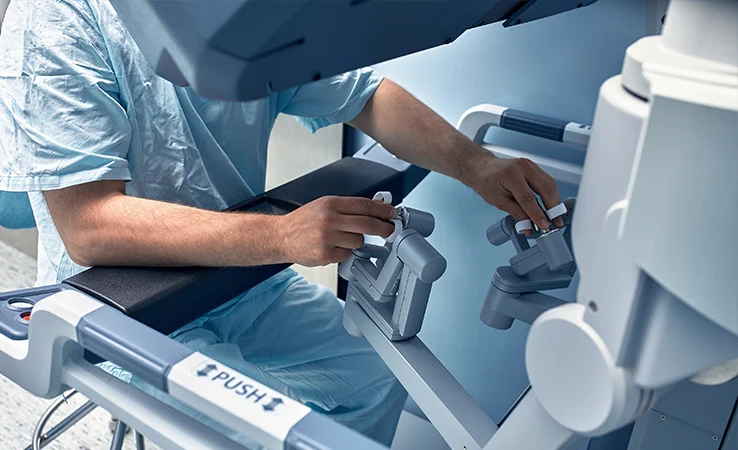
Robotic surgery is an advanced medical technique that integrates robotic systems with surgical procedures to enhance precision, accuracy, and patient outcomes. These systems provide surgeons with greater control, allowing for minimally invasive procedures that reduce trauma to surrounding tissues.

In orthopaedic surgery, robotic systems assist in joint replacements, spinal surgeries, and other musculoskeletal procedures by providing detailed preoperative planning and real-time intraoperative guidance.

Although excellent results can be achieved using conventional joint replacement techniques, Dr Alan Cheung believes that robotic surgery can give increased accuracy, better preoperative planning, and reliable, reproducible results particularly in technically challenging and revision cases.

Benefits of Robotic Surgery in Orthopaedics

  • Enhanced Precision: Robotic systems assist in accurate bone cutting and implant placement, reducing human error
  • Minimally Invasive Approach: Smaller incisions result in less tissue damage, reduced blood loss, and faster recovery
  • Improved Implant Longevity: Precise alignment of prosthetics reduces wear and enhances implant durability
  • Reduced Complications: The technology minimizes surgical errors and improves patient outcomes
  • Faster Recovery Time: With less trauma to surrounding tissues, patients experience quicker rehabilitation
  • Personalized Surgery: Pre-operative planning allows for tailored procedures based on the patient’s anatomy

Dr Alan Cheung is one of few surgeons in Asia to be highly trained and experienced in various robotic systems currently available for joint replacement.

CALL US WHATSAPP

Common Orthopaedic Surgeries that Use Robots

Robotic-assisted surgery is increasingly used in various orthopaedic procedures, including:

  • Total Knee Replacement (TKR) – Enhances precision in aligning and positioning implants, improving joint functionality and longevity
  • Partial Knee Replacement (PKR) – Helps preserve healthy bone and tissue while ensuring accurate implant placement
  • Total Hip Replacement (THR) – Assists in optimal positioning of hip implants, reducing dislocation risk and improving mobility
  • Shoulder Replacement – Ensures accurate bone preparation and implant positioning

Robotic Systems in Orthopaedic Surgery

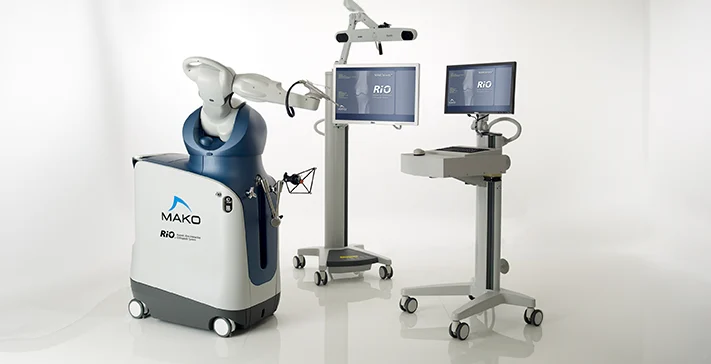
MAKOplasty System

MAKOplasty, developed by Stryker, is a robotic-assisted system primarily used for knee and hip replacement surgeries. It utilizes a 3D CT scan to create a preoperative surgical plan tailored to the patient’s anatomy. During surgery, the system provides real-time feedback, allowing the surgeon to make precise bone cuts and implant placements while preserving surrounding healthy tissue. This results in improved joint function and longevity.

Dr Alan Cheung was certified in the use of the Makoplasty robot at the Homer Stryker Centre in Mahwah, New Jersey, USA.

It is important to understand that the MAKO system does not actually perform the surgery. Surgery is still performed by Dr Cheung, who will first use the MAKO System software to pre-plan your surgery.

This includes a CT scan of your joint that is used to generate a 3D virtual model of your unique anatomy. This virtual model is then loaded into the MAKO system software and is used to create your personalized pre-operative plan.

The implants can be positioned in any position that Dr Cheung thinks suits you best on the 3D map. He then uses a robotic arm to remove the exact amount of bone required. Haptic (tactile) feedback, as well as visual and auditory cues, are given to help prevent him from straying outside the preplanned area.

Early results so far are very promising. In a multicentre study, 909 knees underwent partial knee replacement using robotic-assisted surgery. There was a knee replacement survivorship of 98.8% at 2.5 years, with 92% of patients very satisfied or satisfied with their knee function.

Navio System

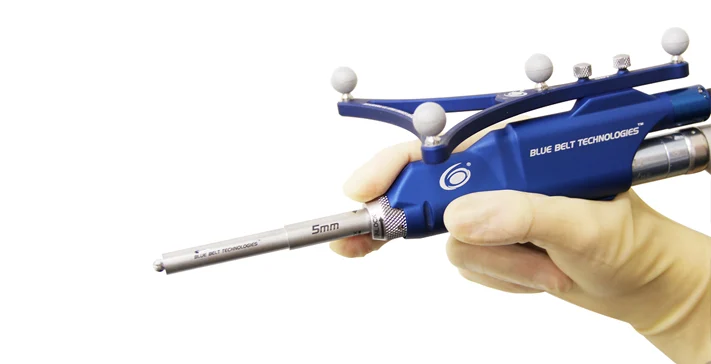
The Navio system, developed by Smith & Nephew, is a handheld robotic-assisted platform used in knee replacement surgeries. Unlike other systems that rely on preoperative CT scans, Navio uses real-time imaging and mapping to create a customized surgical plan. This eliminates exposure to preoperative radiation while ensuring precise bone cuts and implant alignment.

Dr Alan Cheung underwent his training in the Navio system (Smith and Nephew) at the Scripps Mercy Hospital in San Diego, California USA.

The Navio system uses a robotic handheld burr to assist with partial and total knee replacements. The difference with this system is that there is no preoperative CT scan. Instead, the surgeon registers a number of points on the bone of the joint surface to be operated on, creating an intraoperative 3D map of the knee joint. This enables “real time imaging” during the surgery.

The Navio handpiece is used to burr away the desired bone according to a patient-specific plan. Although the Navio equipment is smaller and more portable than a MAKOplasty machine, it does not provide haptic (tactile) feedback, and it is vital that the surgeon accurately registers the intraoperative points, as there is no CT-based 3D virtual model.

Early results from the Navio system are promising. A study in France looked at unicompartmental knee replacements (UKR) performed in 80 patients using the Navio system. These patients were matched with 80 patients undergoing UKR using the same prosthesis, implanted using a non-robotic technique.

At around two years, the patients with Navio assisted surgery had better limb alignment and a lower revision rate. The accuracy of implant positioning is improved by the Navio robotic-assisted system.

ROBODOC System

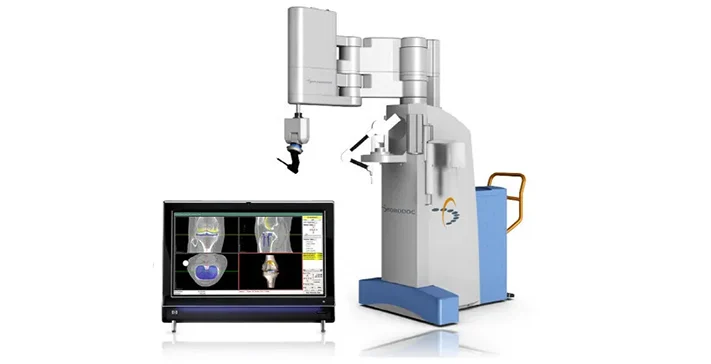
ROBODOC, developed by Curexo Technology, was one of the first robotic-assisted surgical systems introduced in orthopaedics. It is primarily used for total hip and knee replacements, offering unparalleled precision in bone preparation. By eliminating manual inconsistencies, ROBODOC enhances the accuracy of implant fit, reducing postoperative complications and ensuring better long-term results.

Dr Alan Cheung underwent his training in the ROBODOC system at the Mirae Hospital in Busan, South Korea.

It relies on a preoperative CT scan of the limb to create a 3D plan, which the surgeon then uses to map regions of the joint during surgery. The difference between ROBODOC and the other systems is that the robot is fully autonomous (i.e. self guided).

Once Dr Cheung has guided the robot cutter arm to the bone surface, the ROBODOC machine will automatically mill away the bone without any guidance. Dr Cheung is in control at all times and can stop the procedure at any point if required. He then manually implants the joint replacement as per usual.

There is evidence to suggest that the Robodoc system has some advantages in performing total knee replacement and total hip replacement.

How is Robotic Surgery Performed?

Robotic-assisted orthopaedic surgery follows a structured process:

  • Preoperative Planning: A CT scan or real-time imaging is used to create a 3D model of the patient’s joint, allowing surgeons to develop a customized surgical plan.
  • Intraoperative Guidance: The robotic system provides real-time data, guiding the surgeon in making precise bone cuts and implant placements.
  • Robotic-Assisted Execution: The system ensures controlled movements, preventing excessive bone removal and optimizing implant positioning.
  • Postoperative Assessment: The surgeon evaluates the placement and function of the implant before concluding the surgery.

Risks of Robotic Surgery

While robotic-assisted surgery offers numerous benefits, there are still potential risks, including:

  • Higher Cost: Robotic systems are expensive, increasing the overall cost of surgery
  • Steep Learning Curve: Surgeons require specialised training to operate robotic systems effectively
  • Potential Technical Failures: Malfunctions in robotic systems can disrupt surgery
  • Prolonged Surgery Time: Initial cases may take longer as surgeons familiarize themselves with the system
  • Limited Availability: Not all medical centers have access to robotic technology
  • Patient-Specific Risks: As with any surgery, risks like infection, nerve damage, and blood clots remain
START YOUR CARE JOURNEY
Contact Us Today

For more information about our services, or to make an appointment, please reach out to us. We will get back to you as soon as possible.

Call us
+65 6253 7111
Whatsapp us
+65 8828 7111

Frequently Asked Questions

No, robotic surgery is surgeon-controlled. The robot enhances precision, but the surgeon makes all critical decisions and performs the procedure under robotic guidance.

Robotic joint replacement surgeries typically take about the same time as conventional procedures, usually between 1 to 2 hours, but may be slightly longer in complex cases.

Yes, robotic surgery is considered safe. It minimizes human errors, enhances accuracy, and reduces complications, but, like any procedure, it carries inherent surgical risks.

Yes, due to smaller incisions, reduced tissue trauma, and precise implant placement, many patients experience quicker recovery and return to normal activities faster.

Not necessarily. While robotic surgery benefits many patients, factors like bone quality, pre-existing conditions, and patient anatomy determine suitability.

Coverage varies depending on the healthcare provider and policy. It’s advisable to check with your insurance company regarding robotic-assisted surgical procedures.

References

  • Roche M at al. Robotic-assisted unicompartmental knee arthroplasty: the MAKO experience. Orthop Clin North Am.2015 Jan;46(1):125-31.
  • Werner SD et al. Makoplasty and the accuracy and efficacy of robotic-assisted arthroplasty. Surg Technol Int. 2014 Mar;24:302-6.
  • Deese JM et al. Patient reported and clinical outcomes of robotic-arm assisted unicondylar knee arthroplasty: Minimum two year follow-up. J Orthop. 2018 Aug 16;15(3):847-853.
  • Pearle AD et al. Survivorship and patient satisfaction of robotic-assisted medial unicompartmental knee arthroplasty at a minimum two-year follow-up. Knee. 2017 Mar;24(2):419-428.
  • Batailler C et al. Improved implant position and lower revision rate with robotic-assisted unicompartmental knee arthroplasty. Knee Surg Sports Traumatol Arthrosc. 2018 Jul 31
  • Liow MH et al. Early experiences with robot-assisted total knee arthroplasty using the DigiMatch™ ROBODOC® surgical system. Singapore Med J.2014 Oct;55(10):529-34.
  • Nakamura N et al. A comparison between robotic-assisted and manual implantation of cementless total hip arthroplasty. Clin Orthop Relat Res. 2010;468(4):1072-1081.

Our Robotic Surgery Specialist in Singapore

Dr Alan Cheung

Senior Consultant Orthopaedic Surgeon | Director of the International Orthopaedic Clinic (IOC)

MBBS (London)
MRCS (Royal College of Surgeons of England)
FRCS (Trauma and Orthopaedics)
Diploma in Sport and Exercise Medicine
(Faculty of Sport and Exercise Medicine UK)

Dr Alan Cheung is a Senior Consultant Orthopaedic Surgeon with a keen focus on treating sports injuries, adult joint reconstruction and robotic surgery (Makoplasty, Navio & Robodoc). As an avid sportsperson who is actively involved in the sporting scene, Dr Cheung empathises deeply with the needs of athletes. As a trusted orthopaedic specialist, Dr Cheung has published in numerous peer-reviewed journals and has presented at various international conferences.

  • Fellowship in Joint Reconstruction & Musculoskeletal Oncology
  • Fellowship of the European Board of Orthopaedics & Traumatology
  • Asia Pacific Knee Arthroscopy and Sports Medicine Society
  • American Academy of Orthopaedic Surgeons (AAOS)
Read Full Bio